
 Politixia


At a certain point, a fire creates its own wind.
That’s how Craig Keister, owner of Tra Vigne antique group shop, described the current state of Walla Walla’s downtown, where more and more storefronts are becoming empty.
Marge Keister, left, and her husband Craig Keister, owners of Tra Vigne, pose for a photo behind the cashier counter.
“When people come to town — I’m already hearing it from people from the west side — they say, ‘What’s going on downtown? How come there’s so many empty buildings?’” Keister said. “When that fire starts, it’s hard to put out.”
Keister and his wife, Margie, have run Tra Vigne out of the building at 115 E. Main St. for 14 years. This November, they’ll close up shop.
Keister said from what he’s observed, two main factors are causing the decline in downtown business: the suffering wine industry and increased financial pressure on landlords.
“Wineries have been, over the past 15 years, one of the main occupiers of small spaces, small buildings,” Keister said. “And (now) fewer people come into town as part of the wine tourism business. That certainly contributes to lower incomes for a lot of small businesses.”
He said the loss of downtown businesses has resulted in many landlords’ buildings being only partially occupied or not occupied at all. That’s when rents increase for business owners.
“You can’t sustain your income by overcharging the tenants who remain. All that does is contribute to the demise of downtown,” Keister said. “And I think as a property owner, as a business owner, you have responsibility to the community and to your neighbors. I have responsibility to everybody on this block. And I think most small businesses downtown share that feeling, but I don’t know that feeling is shared by all the property owners.”
Paul Bowen, a business adviser with the Washington Small Business Development Center, said Walla Walla had built its strong downtown economy around wine and tourism, but that that market has changed.
“We need to adapt before vacancies and declining traffic force the issue,” Bowen said. “Wine is still a major asset, but we need more economic diversity.”


Bowen, who has worked as a business adviser in Walla Walla since 2019, said the answer is not to abandon wine — it’s to build around it with food, retail, arts, recreation, wellness and other types of business.
“The problem that we have is that these rates are making it very hard to diversify, so traditional retail often can’t support downtown occupancy costs,” Bowen said. “We should probably be looking at exploring more flexible lease opportunities, maybe graduated rents, pop-up opportunities, shared retail space and other incentives for filling long-term vacant storefronts.”
‘The pendulum always swings’
Mary Derby, founder of DAMA Wines, has operated a tasting room downtown since 2007. She said just a few years ago downtown hit a high of about 45 tasting rooms, but several have been lost in the past couple of years.
“Tourism has gone down and consumers are watching their pennies. They’re not spending as much,” Derby said. “But the pendulum always swings. We were like this in ’07 and ’08. When we first started out, the economy was really awful and there were a lot of businesses that were closed here. So things do go back and forth, and you have to hang on tight and hope that you have a community of businesses and people that care about your downtown and want to figure out how to move forward.”

Visitors walk past Dama Wines in downtown Walla Walla on Friday, Oct. 23.
However, Derby said she hadn’t seen downtown so empty since she first moved to Walla Walla in 2000.
“It’s really disheartening,” she said. “I mean, of course rent goes up (over the years). Everything goes up. Nobody’s looking for a handout here, we’re just looking for a fair chance to make our downtown successful.”
She said she was especially sad about Tra Vigne closing because the Keisters have done a good job of looking out for their fellow business owners, keeping the street safe and bringing in a lot of customers.
“I think the biggest challenge we have right now is that the owners of buildings are not necessarily looking for the benefit for the (businesses),” Derby said. “It’s always just the dollar sign that comes into the forefront instead of thinking, ‘What can I do? How can I promote what kind of businesses downtown need? What can I do to move us forward instead of another business closing because they can’t afford rent?'”
Derby said she’d like to see City Council more involved in finding solutions to these issues. She said it might be beneficial for local businesses to start some sort of committee or coalition to talk about what’s working and what’s not working so they can come up with a plan to improve downtown and bring it to City Council.
“There’s got to be this system where we can help each other out, because Walla Walla is about small businesses,” she said. “That is the beauty of Walla Walla. It has always been about family-run businesses. And I’d hate to have us lose it.”

Tastings available at Dama Wines.

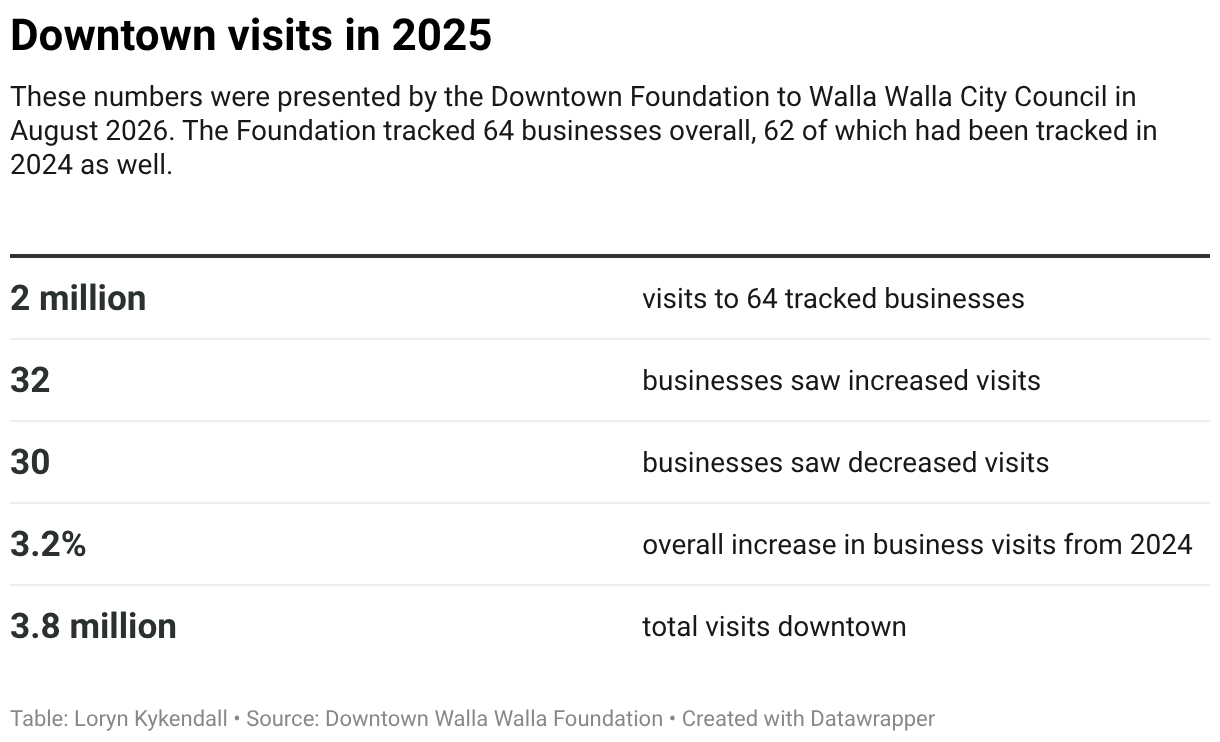
City Council met in August with former Downtown Foundation Executive Director Mallory Nash for the annual Foundation update, where they discussed the issues facing downtown businesses.
Nash told the council that in 2025, 20 new businesses opened and 15 closed. As of August, there were at least 30 empty storefronts downtown.
The Foundation also surveyed downtown businesses. High rent and lease terms were the most consistently identified barrier for business owners, followed by concerns about vacancies, foot traffic, parking, visibility and business diversity.
“Downtown needs more of a coordinated effort,” Nash said during the August work session. “Downtown already has great assets, active partners, significant programming and ongoing investment, but the opportunity is really to connect those pieces. What the data is telling us is that the challenges are interconnected. Visitation, business performance, local engagement, vacancy affordability and redevelopment all influence each other. There’s no single event, program, organization, property owner or public agency that’s going to be able to address them alone.”
Nash told the City Council that what’s happening in Walla Walla is happening across the country, but where it goes from here is a matter of how we approach it locally.
City Council members asked how they could help. Nash said because many vacant buildings are old and need repairs that new business owners might not be able to afford or that building owners aren’t willing to help with, mixed-use buildings might be a solution in some cases. A building that hosts businesses on the bottom floor and is residential on the top floor might result in less expensive maintenance and repairs for owners.
Council member Monte Willis said many local officials had advocated for mixed-use buildings for decades because of the costs that can be saved. It can minimize requirements for fire suppression or elevators, for example. Willis said the Die Brucke building used to be mixed-use with residential spaces upstairs, but a change in ownership at some point ended in the residential spaces being removed.
“Something I think is still an issue the foundation could really help with, which that was probably the biggest reason why the tenant or the owner at that time made the choice to rip all that out, was there was no long-term parking close enough that the tenants would use,” Willis said. “And so that’s something, so much in our downtown circles back to — parking. From my perspective, one of the things the Downtown Foundation could do a lot of work on and help us get our arms around is parking.”
Willis added that there’s a perception that Walla Walla has some wealthy landowners who have come to town, bought downtown property and are now letting properties sit empty and hoping someone willing to pay high rent will come along.
Nash said there were many property owners that are flexible, even offering the first few months of rent free, but then there are other property owners who she did not have contact with.
“I think what I would love to do is get all the property owners to come and have a meeting at the same time and just be completely transparent about how we tackle this,” Nash said. “I’m pretty direct and transparent and a straight shooter. I just don’t see why we can’t work together to solve it.”
Nash is no longer at the foundation, which is hiring a new director.
‘Unsupportable’
As a longtime downtown business owner, Keister has felt the impact of rising rates.
“This building sat for almost six years before I came in. It had problems. For reasonable rent, I accepted that,” Keister said. “But now the rent is unreasonable, unsupportable by any metrics.”
The 6,000-square-foot building has been listed for lease by Windermere on LoopNet at a rental rate of $16 per square foot per year, which equates to about $8,000 per month. The listing was recently taken down, although Keister said the building has not been rented out yet, with only one applicant whose application was denied.
Keister said on top of the $8,000 rent, the owners are charging for a triple net lease, which will add on about $1,500 a month to the rent. A triple net lease is when the tenant pays for rent as well as insurance, maintenance and taxes.
Tax documents provided with the previous listing for the building show that property tax rates are the highest they’ve been in several years, at $7,736 this year. In 2024, property taxes at Tra Vigne cost about $3,700, but spiked to $7,000 in 2025.
Many other downtown properties listed for rent show similar tax rates.

A sign on the right corner of Tra Vigne shows that the shop’s building is available for lease.
The owners of 115 E. Main St. had not responded to requests for comment as of Friday, Oct. 23.
Keister said he’d seen other small businesses have to leave downtown or close completely because they were priced out of their space with high rents. He’s heard people suggest taxing empty buildings, but he doesn’t agree with it. While there are a few excellent property owners downtown who do everything they can to help out business owners, he said, that’s not true for all of them.
“If you (a property owner) pay $1 million for a building, you can’t now base your rents on what you paid. You have to deal with what the market supports,” Keister said. “There’s only so much that a small business can absorb and produce. And typically, these small retail stores don’t make the same money as a professional office or a financial institution. But if these buildings end up as all financial institutions and attorney’s offices, there’ll be no viable downtown.”
Across the state and country, not just in downtown Walla Walla, property and business owners’ costs are rising for insurance, labor, taxes, utilities, cost of goods and maintenance fees.
“I think oftentimes people look to organizations like the SBDC and say, ‘Well, we just need more stores in here like this,’” Bowen said. “That’s fantastic, but if they’re not going to survive because of the cost of doing business, it does them no good. It’s just hurting them. So from an economic development standpoint, we need to focus less on simply filling those storefronts and more on creating conditions that allow businesses to remain profitable long term.”

Shoppers browse through the different vendor booths at Tra Vigne.
He said it’s also not simply a landlord issue. Even if lease rates went down, there would still be other issues to tackle. Tenant improvement costs, for example, can be a big burden for business owners.
“We need more collaboration between property owners, businesses and economic development organizations to find workable lease structures, but also to look at this from a regulatory standpoint to see what opportunities exist to find reprieve for business owners that want to put money into the property to make the business look good, feel good, operate and function well,” Bowen said.
Changes also need to be made on a statewide level, he said. Regulation compliance costs continue to add pressure to small businesses across the state.

“Heaven’s sake, I just helped somebody yesterday that wanted to put a small business in downtown, a service-related business,” Bowen said. “And looking at some of the regulatory costs … they’re writing a check for $1,000 before they even get started. And that’s just the application for some of the endorsements they need.”






GIPHY App Key not set. Please check settings