

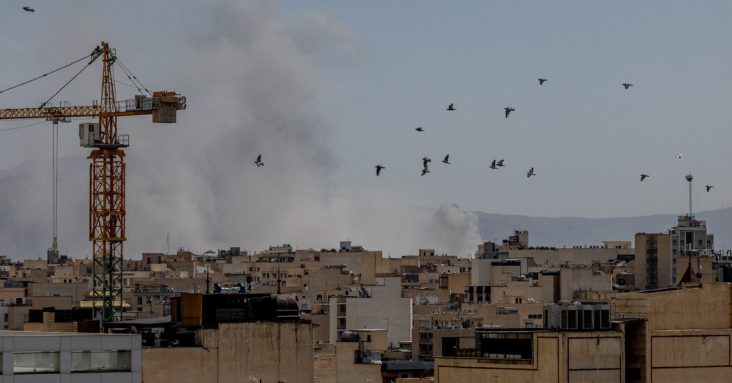

The United States and Iran reached an agreement to end hostilities, reopen the Strait of Hormuz and lift an American naval blockade on ships traveling to and from Iranian ports, President Trump said on Sunday.
In a post on social media, Mr. Trump said the agreement would end Iran’s effective blockade of the strait, a vital waterway that has been at a near standstill since the U.S. and Israel attacked Iran in late February. At the same time, he said he had authorized the “immediate” end of a U.S. naval blockade on Iranian ports.
“Ships of the World, start your engines,” Mr. trump wrote. “Let the oil flow!”
Shehbaz Sharif, the prime minister of Pakistan, a key mediator, said that the agreement would lead to an “immediate and permanent cessation of military activity in all theaters, including in Lebanon.”
Earlier on Sunday, Mr. Trump had called on Israel and Hezbollah, the Iranian-backed militant group in Lebanon that has been at war with Israel, to exercise restraint so as not to disrupt a potential deal.
Talks between U.S. and Iranian negotiators had been deadlocked for months over Iran’s nuclear program and control of the Strait of Hormuz.
The strait is a critical waterway through which a significant portion of the world’s oil and natural gas supply travels. Iran effectively blocked it by striking commercial vessels in response to the U.S.-Israeli attack, driving up global energy prices.
Mr. Trump cast the attacks on Iran in part as an effort to encourage Iranians to topple their theocratic leadership. It was the second time in less than a year that Mr. Trump directly involved the United States in strikes on the country.
The conflict quickly spread, with Iran attacking countries in the Persian Gulf that host American military installations and reigniting fighting in Lebanon between Israel and Hezbollah. Thousands of people have died, mostly in Iran and Lebanon, hundreds of thousands have been displaced, and the global economy has been badly rattled.
Here are some key moments in the war:
February
Feb. 28: The United States and Israel launched strikes across Iran, hitting a government compound in Tehran and military targets. The blasts killed Ayatollah Ali Khamenei, the nation’s supreme leader for almost 37 years, as well as other high-level military and intelligence leaders.
At least 175 people, most of them probably children, were killed in a strike on a girls’ elementary school in southern Iran, health officials and Iranian state media said. The strike was a targeting mistake by the U.S. military, according to U.S. officials familiar with a military investigation.
Iran retaliated for the U.S.-Israeli assault by firing missiles and drones at Israel and at U.S. military bases in the region, including in Qatar, Kuwait and the United Arab Emirates.
March
March 1: An Iranian drone attack killed six U.S. soldiers in Port Shuaiba, Kuwait, the first Americans to die in the war.
Hezbollah, the Iranian-backed militant group, dragged Lebanon into the conflict, firing rockets toward Israel in retaliation for the killing of Iran’s supreme leader.
In a brief telephone interview with The New York Times, Mr. Trump said the United States and Israel intended to sustain their assault on Iran for about “four to five weeks.”
March 8: With several top Iranian leaders killed in airstrikes, Iran named Mojtaba Khamenei, a son of the slain supreme leader, as his father’s successor. Ayatollah Khamenei, 56, was appointed by a committee of senior Shiite clerics, signaling continuity and defiance after Mr. Trump called him an “unacceptable” choice.
March 11: Iran escalated its attacks in and around the Strait of Hormuz, striking at least three ships. The attacks sent oil prices surging and the Trump administration scrambling to calm global markets.
March 12: Six American crew members died after a KC-135 military refueling aircraft crashed in Iraq, bringing the number of U.S. service members killed in the war to at least 13.






GIPHY App Key not set. Please check settings