

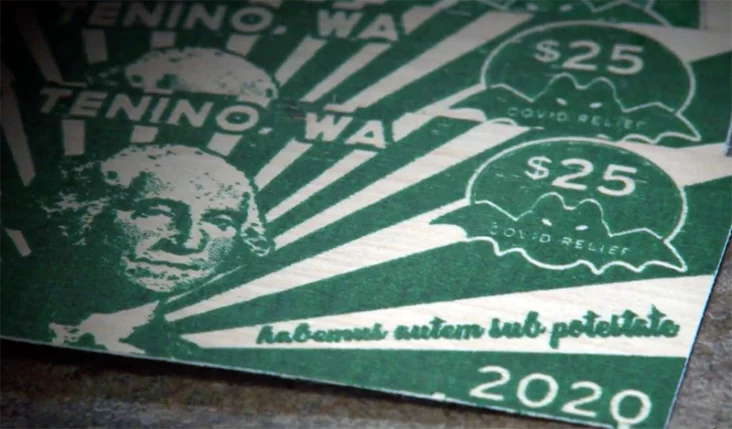

Today’s wooden bills are printed using the same machine as the one used back then: an 1890 Chandler and Price platen press.

Just about every business in town, including the gas station, auto-body shop, and drug store, accepts the wooden money. Businesses, in turn, can redeem the currency at City Hall for cold, hard — and paper — cash.
For Tenino residents like Laurie Mahlenbrei, a school bus driver, the wooden money has been a godsend, helping her to cope while she’s been out of work. She’s used it to buy groceries at the market, using one slice of wood to pay for a whole basket’s worth of items, including blue-cheese salad dressing, butter, ground turkey, cans of grain-free dog food, and a new toothbrush.
“Every once in a while, I run into a cashier that hasn’t taken [the wooden money] before,” she told CBS News. “But it’s just a blast, you know? I mean, I’m paying for food with something historical, you know?”
The uniqueness of the wooden money program has long caught the attention of collectors. In 1933, when Tenino ceased printing the scrip, only $40 of the total $10,308 put into circulation was redeemed, Secretary of State Kim Wyman wrote on her blog “From Our Corner.” The rest of the wooden money was kept as souvenirs or sold as collector’s items.






GIPHY App Key not set. Please check settings