
 Politixia

MILI
Sixteen years after Jon arrived in Argentina, I spent a semester studying and reporting in Buenos Aires.
As a sophomore who had recently declared a minor in Spanish, I saw New York University’s expansive study-abroad program as an opportunity to put my growing language skills to use. Before traveling to a country I had never imagined myself visiting and knew little about, I spoke with other Black students who had studied at the university’s sole South American site. They warned me that I would be stared at, touched without permission, overtly sexualized and subjected to invasive questions about my hair, body and identity.
They were right.
My Blackness made me hypervisible. Yet Afro-Argentines faced the opposite: invisibility, buried beneath a national mythology that Argentina was white because its Black population had simply disappeared.
But the Black communities I met rejected that story.
During my semester abroad, I interned with DIAFAR, a Black-led organization fighting the historical and political erasure of Afro-Argentines. I translated articles from its newspaper, El Afroargentino, from Spanish into English. Additionally, I worked with Agrupación Xangô, where I helped young members practice English ahead of a cultural exchange in the United States. Through that organization, I met and profiled Carlos Álvarez Nazareno, an Afro-Uruguayan and Argentine activist whose work challenged the country to recognize the Black people it had written out of its national identity.
I also reported on other Black activists and African migrants whose lives complicated the belief that Blackness was extinct or inherently foreign to Argentina. The people I met represented distinct histories of Blackness in Argentina. Some were Afro-Argentines whose roots in the country stretched back generations. Others had migrated from elsewhere in Latin America and the Caribbean, while newer African migrants were building lives in a nation that treated Blackness as alien and threatening.
One of those migrants was Moustafa Sene, who arrived in Argentina from Senegal at 23 in 2007.
When Sene first came to Buenos Aires, he told me, he could walk through parts of the city for an entire day without seeing another Black person. By the time I interviewed him in 2018, that had changed dramatically.
“You walk seven or 10 blocks and you usually see an African,” he told me in a quick, soft Spanish.
Sene estimated that roughly 4,500 Senegalese migrants were living in Argentina at the time.
Many had arrived in Argentina searching for economic opportunity, driven by limited job prospects for young people in Senegal. Historically, he said, most Senegalese migration remained within Africa, with migrants moving to countries including Côte d’Ivoire, Gabon, Liberia and South Africa before larger numbers began moving to Europe. As European countries made migration more difficult, newer destinations in Latin America became increasingly attractive.
But arriving in Argentina presented its own challenges.
Most Senegalese migrants did not speak Spanish when they arrived. Many learned the language informally through daily life and street work rather than in classrooms. Some had limited formal schooling, making it even harder to navigate a new language, government bureaucracy and job market.
Many make their living selling jewelry, clothing and other goods on the street, placing vendors in direct conflict with police harassment, violence, arrests and confiscation of merchandise.
These dangers came with consequences.
In 2016, Senegalese activist Massar Ba was found gravely injured on a city street, reportedly crying out that someone wanted to kill him. He had suffered severe injuries to the head, hip, and lower abdomen, but despite the gravity of his injuries, the police arrived late, and only to call an ambulance. He died in the hospital the following day.
Ba was a prominent advocate for Senegalese street vendors facing police harassment, and had previously filed a complaint against the Metropolitan Police over their treatment. His death became a rallying point for Afro-Argentine and African migrant organizers — including Sene and Nazareno — who demanded an investigation, connecting his case to the broader racism and institutional violence facing Black people in Argentina (as officers did not secure the scene or preserve evidence, leaving community members themselves to identify nearby surveillance cameras that might have captured what happened.
“Many people see us as inferior because our ancestors were enslaved. So because the white man was the master, today they want to think — or make us believe — that we still have the role of the slave and that they are still the masters…That’s not how it is. That is history now. We are going to keep fighting and defending ourselves so that it never happens again.”
Moustafa Sene
JON
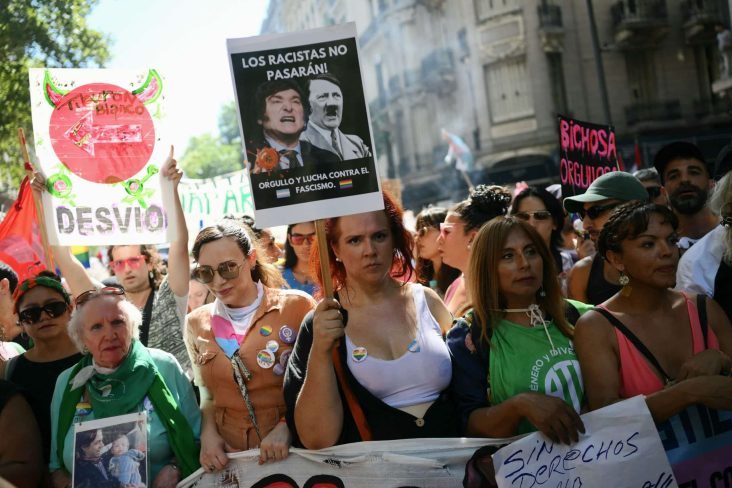
As World Cup fans all over the world testified, however, racism in Argentina has indeed amplified over the span of a generation as Wall Street’s austerity policies have transformed the economy into a mirror of the United States’—savagely unequal—and Trump’s mini-me President Javier Milei has stoked dormant tribal resentments to legitimize the widening gap between the rich and poor.
A Google search of racially motivated police killings in Argentina turns up only one, 17-year-old Lucas González, who was tortured and fatally shot by plainclothes officers in 2021. González was mixed-race.
“They stigmatized them [González and his friends] because they were ‘morochos’ [brown-skinned], because they came from a deprived neighborhood,” the boy’s father, Hector, told reporters at the time. “They saw them, they waited for them, they tortured them, they burned his body with cigarettes.” Three police officers were convicted of “aggravated homicide with malice and racial hatred.”
Alan Cibils, a white Argentine economist and retired professor of political economy at the Universidad Nacional de General Sarmiento in Buenos Aires, told the Kansas City Defender in a phone interview:
“Is Argentina racist or not is a valid question and one that we should be debating more,” he said. “Of course, any country founded on European settler colonialism is racist from the very foundation…The racial superiority of the Spanish and the Portuguese endures til this day in Argentina… but the most racist country in the world is quite an exaggeration.”
Still, Cibils acknowledged that there has been an uptick of racism in recent years, coinciding with the 2015 presidential election of a conservative businessman, Mauricio Macri, followed by Milei’s election as president eight years later. Claiming that “woke is nothing more than a systematic plan…to justify state intervention and increase public spending,” Milei has proclaimed his political affiliation with Trump and aped his crusade against multiculturalism by closing the Ministry of Women, Gender and Diversity and the National Institute against Discrimination, Xenophobia, and Racism. Moreover, police in Buenos Aires have begun to crack down on immigrant Senegalese street vendors under the leadership of Milei and the city’s mayor, Jorge Macri, the former president’s brother.
Said Cibils:
“Milei has a very xenophobic and misogynistic agenda… the repression targets poor people or anyone who protests. He is against anything and everything that promotes rights for excluded populations. That has enabled certain sectors of society to express their (bigotry) freely where they might have not been comfortable expressing it before.”
Alan Cibils, economist
MILI
Under Milei, Argentina’s rightward turn has accelerated. But for Black Argentines and African migrants, neither the racism exposed during the World Cup nor the country’s political shift to the right began with him.
Former President Mauricio Macri marked Argentina’s first major rightward turn in recent years, but Carlos said his government ultimately failed to carry out the sweeping structural changes it sought. Under Milei, that project has moved faster and with greater force.
“Macri was the first government from the right to get power, but he couldn’t make strong changes,” he said. “But this neoliberalism is going faster than Macri.”
Milei has also benefited from powerful support abroad, particularly from the Trump administration. In 2025, the U.S. government pledged up to $20 billion to help stabilize Argentina’s struggling economy, while the IMF separately approved another $20 billion in loans.
For Black Argentines and African migrants, then, the deeper story is not that racism suddenly appeared with Milei. It is that longstanding racism has become more visible, more politically permissible and more materially consequential.
Eight years after my time abroad, Argentina’s World Cup run brought Nazareno and me back into conversation.






GIPHY App Key not set. Please check settings