

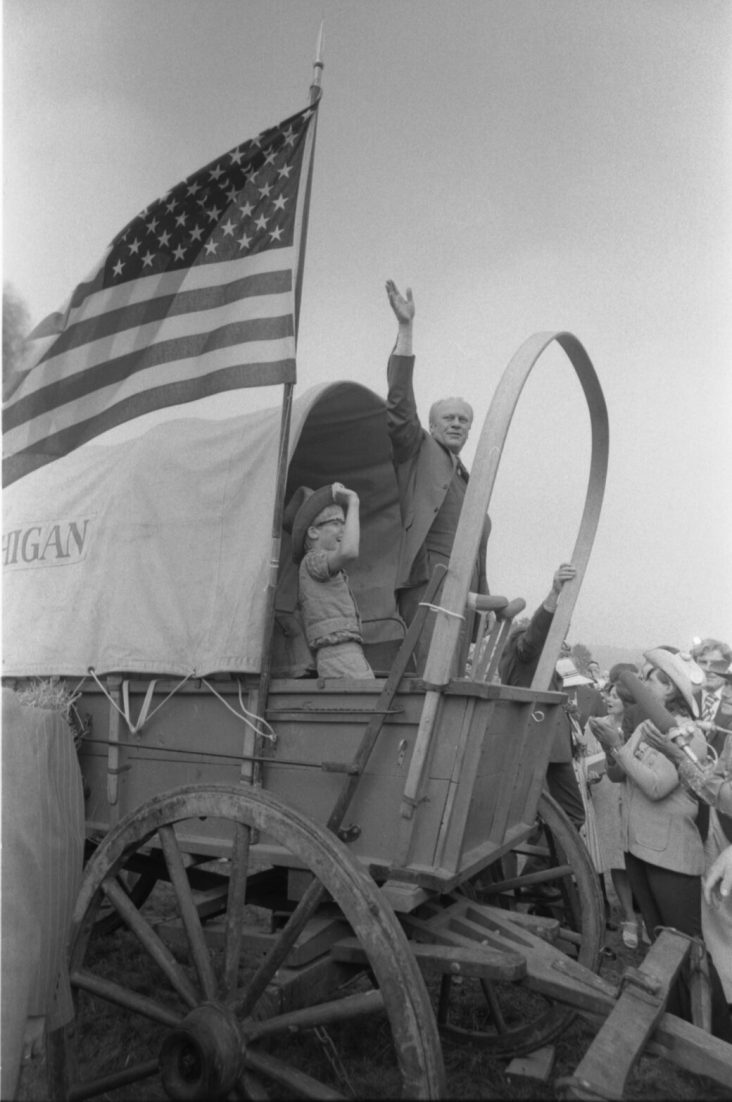

On the morning of July 4, 1976, the Washington Post published a proclamation drafted by President Gerald R. Ford in honor of the United States’s Bicentennial – the 200th anniversary of American Independence:
“Two hundred years ago we, the people of the United States of America, began a great adventure which stirred the imagination and quickened the hopes of men and women throughout the world…Two centuries later, as we celebrate our bicentennial year of independence, the great American adventure continues.”1
That morning, Ford embarked on his own great American adventure. He traveled over five hundred miles by car, airplane, and helicopter to attend Bicentennial events in Washington, D.C.; Valley Forge, Pennsylvania; Philadelphia, and New York City before returning to the White House in time for fireworks on the National Mall. Accompanied by his eighteen-year-old-daughter Susan Ford and members of the press (First Lady Betty Ford joined him for events later in the day), Ford’s whirlwind day of travel, speeches, and bill-signings helped usher in America’s 200th birthday. Ford and his staff planned the entire day down to the minute to allow the president to attend as many Bicentennial events as possible and share in the celebrations with multiple communities up and down the East Coast. Relying on press reports and a detailed diary of Ford’s schedule recorded by his staff, we can recreate the president’s hectic schedule on that historic day.2

For the United States, the Bicentennial celebrations on July 4, 1976 officially kicked off at 4:33 a.m. with a flag-raising ceremony on top of Mars Hill Mountain in Maine, where sunrise first touched American soil.3 President Ford’s day began soon after. At 6:52 a.m., the president left the White House and drove across Lafayette Square to St. John’s Episcopal Church (known as the “Church of the Presidents”). He and his daughter Susan attended a special Bicentennial communion service, after which they returned briefly to the Residence for ten minutes. But by 7:40 a.m. they were back outside on the South Lawn where the presidential helicopter sat ready to pick them up. They flew an hour and fifteen minutes to Valley Forge, Pennsylvania, the site of the Continental Army’s winter quarters during the War for Independence where General George Washington willed his troops to persevere through hardship and thus kept the hope of the Revolution alive. Two centuries later, Valley Forge was the final destination for a national wagon train organized in honor of the Bicentennial. Channeling the spirit of their pioneer ancestors, thousands of citizens from across the country built wagons and rode them from their respective states over 17,000 miles to rendezvous at Valley Forge, where President Ford was there to greet them. He and Susan arrived via helicopter at 9:05 a.m., but dense fog prevented them from landing immediately. They circled Valley Forge for fifteen minutes, waiting for the fog to dissipate. The president’s aides reported that if the fog had lasted another five minutes, Ford would have had to leave without landing to proceed to his next event due to the day’s tight schedule. Fortunately, the fog broke.4








GIPHY App Key not set. Please check settings