
 Politixia

I regret to inform you that woke is over again. On the third Wednesday of every month some Maga St George pops up to tell us all that he has slain the dragon of political correctness. Anyone with a nose ring or blue hair will be henceforth dispatched to a Gulag on the Belcher Islands. Ten minutes later the same rightist is bemoaning the colossal indignity of having to observe their proctologist’s preferred pronouns.

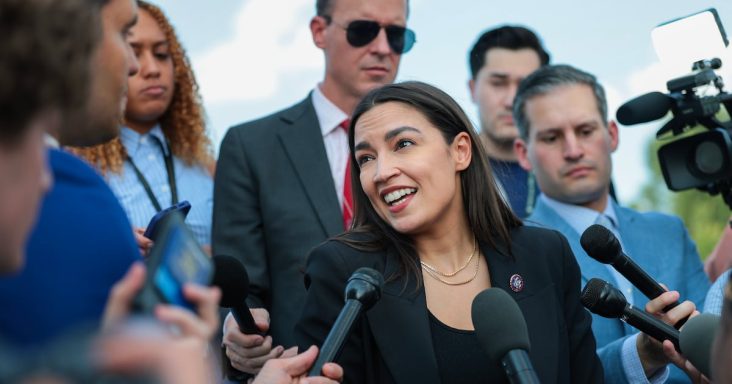
This is a little different. First, it is more of an adjustment than a cancellation. Second, the announcement comes from stage left. It is not quite true to say that Alexandria Ocasio-Cortez, tribune of new(ish) US progressivism, said that “Woke 1.0 was crazyyyy,” but, by quoting the New York City council member Chi Ossé’s words, the congresswoman invited re-evaluation of the movement’s first iteration. “Rhetoric in that time is not rhetoric that we would use today,” she continued on ABC News’s This Week programme.
The sense of relief emanating from left-leaning media (if not exclusively from left-leaning journalists) suggested that AOC may really have been on to something. “Woke 1.0 was crazy, and it isn’t over,” Lee Siegel warned in The New Statesman. “Why ‘Woke 1′ failed feels so obvious now,” Luke Winkie declared in Slate.
In one regard, the initial incarnation of woke was an undeniable disaster. The word itself, mispresented from the beginning, was almost immediately appropriated by the right. The same thing happened to “political correctness” 40 years earlier. Conservative commentators, long after the terms had achieved peak toxicity, behaved as if progressives were still bandying them around daily. “I suppose I am not being ‘woke’ when I call …” they began. You’re the ones constantly using the word. You tell me if you’re woke or not.
The poor old term has honourable roots in black vernacular as far back as the 1930s. For another 80 years or so it did useful work in describing those aware of (or “awake to”) social inequalities. It crept above ground in the first decade of Twitter and gained particular traction – largely through the hashtag #staywoke – during the 2014 protests in Ferguson, Missouri, against aggressive policing.
But what we are really talking about is the sudden deluge of attention that came the word’s way during the pandemic year of 2020. That summer, following the murder of George Floyd by a Minnesota police officer, the word “woke” had brief life as an unambiguous signifier of concerned progressiveness. Ocasio-Cortez, elected to New York’s 14th congressional district in 2019, was among those closely associated with it. Then it quickly entered the conservative bestiary. It remains there today.
It was no accident that AOC referenced a term derived from computing. Woke 1.0 is the first workable application. Woke 2.0 refines and adapts the tool. Subsequent iterations work to perfect it. There is no suggestion the entire project is being trashed. In that TV interview she was careful to focus on language. “Rhetoric” is a key word here.
The wider excitement has a lot to do with the upcoming midterm elections in the United States. Speaking to The New York Times, Spencer Goidel, a political-science professor at Auburn University, in Alabama, looked back to Donald Trump’s defeat of Kamala Harris in the 2024 presidential race.
[ Good riddance to ‘Woke 1.0’, but was any of it necessary?Opens in new window ]
“I think that’s kind of a wake-up call where Democrats then have to self-reflect and go, ‘Oh, we aren’t speaking to the common person,’” he said. “I do think there’s this active effort within the party now to kind of silence a little bit the academic-ese.”
Two weeks ago, Francesca Hong, a democratic-socialist candidate, despite being way ahead in the polls, lost the Democratic primary for governor of Wisconsin to a more moderate opponent.
Did it matter that Hong once felt the United States should abolish the police and “cancel Thanksgiving”? Maybe so. Maybe not. (She did later walk back the statements.) But the perception that might be the case looks to have been significant in itself. The retooling of the app will continue until the message is sufficiently smoothed down.
[ Why Maga sees Europe as an ideological battlegroundOpens in new window ]
The truth is that, as with too much in contemporary politics, this is primarily a story about surface marketing. The social inequalities that inspired the woke reverberations in 2020 continue to challenge politicians. Despite Hong’s failure in Wisconsin, progressive candidates have, for the Democrats, had notable success in various races.
But the language is being tweaked. “Sometimes what you believe can change,” Zohran Mamdani, the progressive mayor of New York, said last week.

For all the rebooting, however, AOC and her colleagues will never quite escape the W-word. It now belongs to the right, and, to quote Charlton Heston on his firearms, the other side will need to prise it from their “cold, dead hands”. Good luck with that.





GIPHY App Key not set. Please check settings