
 Politixia

We saw Schindler’s List, there, and Pulp Fiction and Clueless and Muriel’s Wedding and a host of other films, both critically acclaimed and critically panned.
And while we preferred the quality over the dross, much of the pleasure lay in the ritual itself: the buying of nachos, the adverts, the “experience it in Dolby Digital” trailers, the dimming of the lights before the main attraction. Cinema was so woven into our lives throughout the 90s that when we went back for the first time after a long, baby-related hiatus I cried at the “pa pa pas” of the Pearl and Dean jingle.
We don’t go so much nowadays. It’s expensive, and not working so late allows us to make up for lost time gigs-wise – more set lists, less silver screen – with movies mostly watched on Netflix long after their release date.
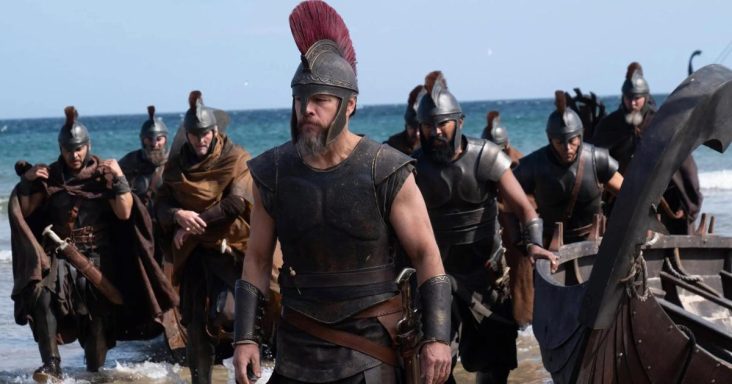
Last weekend, however, by dint of work and fate, I found myself at not one but two big events at the opposite ends of the movie spectrum. In the early afternoon, I travelled to the Broadway – a beautiful art deco Prestwick cinema currently undergoing restoration – to see the gentle British Lion Films comedy The Smallest Show on Earth, while the late evening saw me heading to the Imax at Glasgow Silverburn’s Cineworld for the opening weekend of Christopher Nolan’s The Odyssey.
Reel diversity
IN terms of the setting and subject matter, the two experiences could not have been more diverse: one low-key, the other intense; one domestic, the other epic; one rooted in real life, the other in myth. And yet, what struck me most was the common hunger being fed. Whether sitting on dusty velvet chairs or shiny leather ones, whether watching a young couple chasing a pipe dream, or a cyclops defeated with a red hot stake, what cinema-goers are mostly looking for is a route out of their own lives into other worlds.
Read more:
It also occurred to me that maybe one of the reasons I go less now is because the relentless discourse around the biggest releases dulls the delight. I remember how excited I was when I first heard there was to be a film of Hamnet, a book I’d loved.
But by the time I’d been bombarded by 1,000 hot takes on historical inaccuracy and grief porn, I found my enthusiasm had dissipated to the point I could no longer be bothered. I guess I wanted to see it fresh and unburdened not just by other people’s opinions, but by other people’s need to have and express an opinion – to mark themselves out as going against the grain.
This is not a broadside against bona fide film criticism which is an important art form, ironically on the wane due to cuts and AI. I absolutely want to hear from those with a background in cinema – or, at a push, a background in the subject matter at the heart of the film (for example, Mary Beard or Emily Wilson on The Odyssey). I want to benefit from their wisdom, to be told where this movie sits in the director’s oeuvre, what narrative techniques or special effects they have used and whether – in the writer’s opinion – they have achieved what they set out to achieve.
Nor do I require such film criticism to appear on traditional media or come from traditional sources. I’m as happy to read it on a blogpost as in a newspaper so long as it has been written with a degree of care and in good faith. What I am railing against is the onslaught of performative backlashing and contrarianism from people thirsty for social media traction. That and the insistence of viewing every new release through a narrow ideological prism that has nothing to do with what is unfolding on the screen.
Prince of woke?

IT’S the Culture War, stupid. The extent to which it is ruining everything has been showcased by the reaction to The Odyssey, with much nuanced dissection of its merits and demerits drowned out by those who want to judge it on this binary question: is Nolan a Prince of Woke smuggling his progressive agenda onto our screens like Greeks inside a Trojan Horse, or a misogynist dinosaur determined to excise all the great heroines from Homer’s poem.
The most cursory reading easily debunks each of these contentions. Nolan likes to use actors he already knows and trusts, hence Lupita Nyong’o (who is black) as Helen of Troy and Elliot Page (who is trans) as Sinon. Besides which, how shallow is any discussion of colourblind casting in a film set in a mythological universe?
Equally, the fact the most interesting scene of the film is the one in which Samantha Morton’s Circe is twisting men’s bodies into pigs gives the lie to any notion of this as an anti-feminist film.
Ditto Nolan’s decision to transform her from a seductress to a traumatised woman protecting herself from potential rape by unknown soldiers.
This a difficult conversation to have without sounding fatuous. Of course, cinema has always been political. The other day I watched Vittorio De Sica’s Bicycle Thieves which was released in 1948. Set amongst the poverty-stricken underclass of post-war Rome, It’s hard to conceive of a more powerful risposte to the triumphalism of the Mussolini years and the injustices of capitalism.
It is also legitimate to ask political questions of art or to view it through a particular lens. I am always interested to know if a film passes the Bechdel test (a metric for female representation which dictates it must have at least two named women, they must have a conversation with each other, and that conversation must be about something other than one of the men).
Less enamoured
OFF the top of my head, I think The Odyssey fails it. I am less enamoured of All The President’s Men than most people I know because it reminds me of a time when women were sidelined in newspaper offices. But that does not mean I don’t recognise its qualities, or that I think it should be judged on that basis alone.
It’s the reductiveness of the Culture War discourse I abhor: the way it applauds or decries on the basis of such narrow parameters; the way culture warriors make a film fit their vision of the world rather than coming to it with an open mind and hoping to be wowed. Nolan’s Odysseus has been described as a Rorschach test, a figure so malleable he can mean whatever you want him to mean. But nowadays it feels like every film is a Rorschach test, and something to be weaponised rather than enjoyed.
There’s a Weyes Blood song I love called Movies. Its lyrics are complicated and ambivalent towards Hollywood — they both eulogise the romance films fleetingly bring to our lives and chafe against the false hopes they raise of betterment. But the music those lyrics are set to is anything but ambivalent. It is a lush, nostalgic, dreamy soundscape, a siren call that lures you in.
That’s what most of us want from the cinema, isn’t it? Especially in times when the world outside is so harsh and disappointing. Not endless performative analysis, but to be transported, swept off our feet, allowed to be someone else, somewhere else for as long as the film lasts.






GIPHY App Key not set. Please check settings