
 Politixia
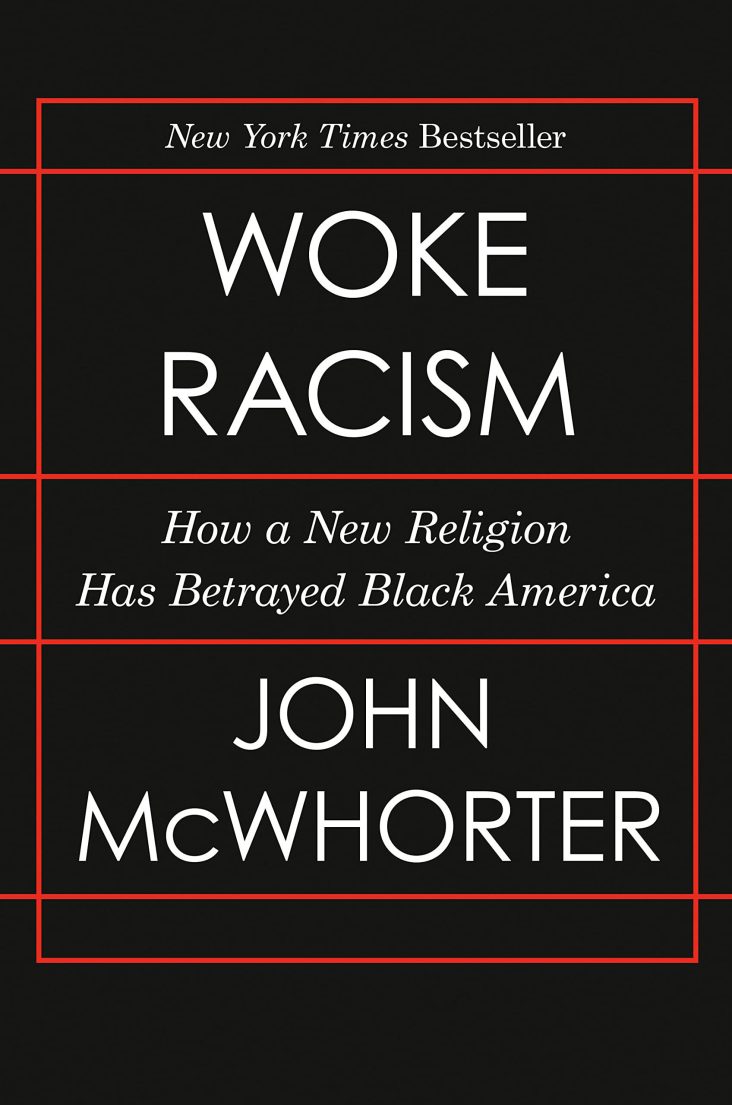

John McWhorter
Woke Racism: How a New Religion Has Betrayed Black America
(Portfolio, 2021)
If the nation’s conversation about race has devolved into epithets hurled at school boards over the (alleged) teaching of critical race theory to six-year-olds, partial credit must go to the writings of Ta-Nehisi Coates (Between the World and Me), Robin DiAngelo (White Fragility), and Ibram X. Kendi (How to Be an Antiracist), widely-known books whose reflections on race have supercharged our conversation with such concepts as white privilege, systemic racism, and white fragility. In politics, the culture war between the “woke” and the unrelentingly unwoke rages on, and we might count casualties in the results of the upcoming 2022 midterm elections.
But it would be wrong to view the conflict as a two-sided fight between enlightened progressives on one side (the antiracists) and Trumpian zealots on the other (racists). There’s another voice in the arena that is arguing vehemently against the “woke” understanding of America’s racial situation. This critic, who proclaims that no, it isn’t racist to be anti-antiracist and who identifies himself as a 1960’s-style progressive liberal, dissects the “KenDiAngelonian religion” as a constellation of dangerous misunderstandings that do more harm than good. In his view, such “Orwellian poppycock” fails to advance the situation of “blacks” in America [throughout the book, McWhorter uses the lower-case “b”] while inspiring a blend of guilt-mongering and witch-hunting puritanism among its (largely white) adherents. This third voice in the “woke” war belongs to the Black social commentator, New York Times columnist, author, radio, television, and podcast personality John McWhorter, whose new book is Woke Racism.
I hesitated above to describe McWhorter as a Black social commentator, guessing that he might better be deemed (as he discussed with Randall Kennedy on a recent podcast) a “social commentator who happens to be Black.” McWhorter’s wisdom extends beyond race (music lately), but the fact that he is Black is highly relevant when it comes to his challenging “woke” thinking, imparting a legitimacy that might not be his were he non-Black. It’s not so easy, in other words, to dismiss him out of hand as just another anti-Black racist (although he has been called that too).
But McWhorter is not only a social commentator who happens to be Black, he is also a linguist who happens to be Black (creole languages are his specialty, for example, not Black English). It is this John McWhorter—the linguist—who serves on the faculty of Columbia University, whom I’ve followed for years, having used his books—Word On The Street (1998) immediately comes to mind—in teaching the history of the English language, as well as in courses for writers and educators on grammar and style.
Not surprisingly, I approached his new Woke Racism wondering whether this other McWhorter, John McWhorter-the-linguist, would show up in its pages and, if so, how that might fine-tune our understanding of his argument and enrich our view of the book.
I didn’t have to look far. There it was on page one, amid passages describing how New York Times food writer Alison Roman was skewered on social media in 2020 and suspended from her position for “having the nerve, as a white woman, to criticize two women of color.” McWhorter’s point here is that “woke” vigilantism has blown things cruelly out of proportion and unjustly ruined people’s lives (Woke Racism contains numerous other examples), but I was struck in the following sentence by a choice of pronoun:
Announcement
Roman, as a white person, was supposedly punching down—i.e. “down” at two people very wealthy, very successful, and vastly better known than her.
Announcement

Than her? Strict grammarians, as McWhorter knows well, would insist on “than she,” but McWhorter, a great champion of how English is actually spoken, goes with the vernacular, with the “natural.” There’s nothing “ungrammatical” in nonstandard dialects, he has written, “nothing illogical … there is no such thing as a deficient dialect of a language” (see page 29 of McWhorter’s Word on the Street).
Why bring this up? In matters linguistic, McWhorter is a language anti-snob, as progressive as they come. Look for a trace of the reactionary, the repressive, the close-minded in McWhorter the language maven—and you won’t find it.
But in Woke Racism, McWhorter’s tone is changed. There’s no playfulness in the alarm he sounds in these pages. Do you know the opening of poet Richard Wilbur’s “Advice to a Prophet”?
When you come, as you soon must, to the streets of our city,
Mad-eyed from stating the obvious…
McWhorter writes with the urgency of a frustrated prophet, insisting that any well-intentioned readers still capable of critical thinking should see the woke experiment for what it is, a fundamentalist but secular “religion” that elevates its practitioners—he refers to them as “the Elect”—to a position of levying judgment on the rest of society and doing little more. He draws a parallel between the Christian doctrine of original sin to the woke stance on white privilege: in woke America, whites from birth are burdened with an inescapable stain of white privilege which, good intentions notwithstanding, makes them complicit with our racist society. To be reborn as antiracists, they must follow the canons of the sacred texts (Coates, DiAngelo, Kendi) and fundamentally change mindsets—theirs and everyone else’s. The woke, whatever their intentions, bear the burdens of systemic racism. They have work to do, even down to the level of figuring out whether it’s safe or hurtful not to capitalize the “b” in “black”—or simply changing the rules and requiring everyone to comply or be canceled.




GIPHY App Key not set. Please check settings