


Authors:
- Viola Lutz – Head of Physical and Transition Risk Center of Excellence, Moody’s
- Chris Lafakis – Director of Economic Research, Moody’s Analytics
- Kamile Rudaviclute – Asst Director Risk Management, Moody’s
- Jake Carr, Director, Moody’s
- Richard Loeser, Director, Moody’s
- Caroline Binkley, Assc. Director, Moody’s
- Elisa Loy, Asst. Director, Moody’s
- Isabel Llorente Garcia, Assc. Director, Moody’s
From damage to impact: A glimpse into natural catastrophes from physical risk in 2050
Analysis from Moody’s estimates that in 2050, the global economic impact of physical risk may reach $41.4 trillion, or a 14.5% loss in gross domestic product (GDP). Roughly two-thirds of this economic loss could be attributed to chronic factors such as sea level rise and productivity loss, with the remaining third attributable to more frequent and severe natural disasters.
The US faces economic losses of 9.5% of GDP by 2050, or $6 trillion. Moreover, on average, the annual damage costs from US natural disasters could be 26% higher in 2050 than in 2020. Within the corporate landscape, Moody’s estimates a 2.0 percentage-point reduction of operating margins, which is equivalent to total damages of $1.5 trillion. A typical commercial real estate (CRE) loan portfolio could see a near 18% increase in default probability and about a 20% increase — more than $200 million — in expected losses.
In this white paper, Moody’s offers perspective and a potential framework for better understanding the impacts of catastrophic events from physical risk in 2050. Starting with the big picture, we outline the macroeconomic impacts of the damages in terms of potential global GDP reductions. We also offer an approach to evaluating the damages of physical risk on real assets, which underpins the insight you need for business decisions. The results, as a pair of case studies, offer balance sheet perspectives in terms of potential credit impacts for corporates and an illustrative CRE loan portfolio.
The need for understanding: Navigating uncertainty and potential shifts in business impact
The long-time horizon of evolving climate risk and its associated uncertainty challenges leaders to think through new approaches on how to assess whether the impacts will be material, how they will affect global and local economies, and ultimately how they should inform and transform current practices in balance sheet management.
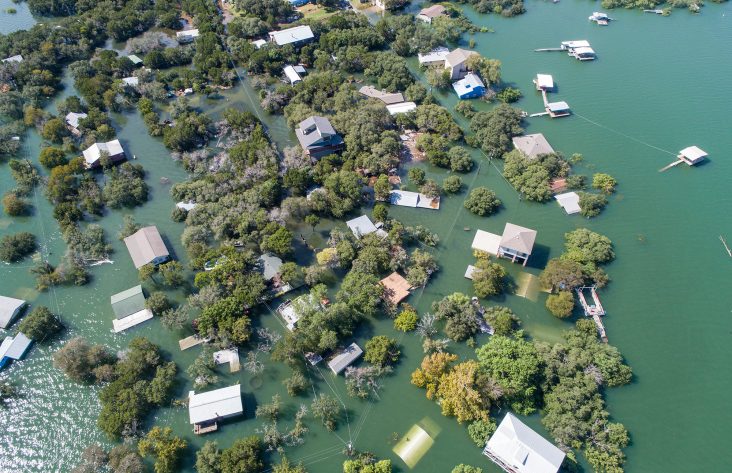
While contemplating physical risk in the long term may seem abstract, we have illustrations today of major catastrophes that provide a baseline for understanding the economic and financial impacts. From the wildfires in Los Angeles to the heat waves in Europe, physical risks are manifesting in catastrophic events with material direct and indirect impacts.
The global natural catastrophes of 2024 caused approximately $320 billion in economic losses and around $140 billion in insured losses according to MunichRe. These results mean that 2024 was the fifth consecutive year of global insured catastrophe losses over $100 billion. Zooming in to the Los Angeles wildfires as an example, Moody’s RMS™ Event Response estimates insured losses from $20 billion-$30 billion.
The best available science and assessment of current policy scenarios suggest even bigger and more frequent disasters as we look further into the future. Moody’s has modeled this evolving physical risk for more than 30 years with rigor and accuracy that insurance regulators have accepted as instrumental in rate filings, demonstrating our ability to develop bottom-up assessments for use cases beyond risk screening to informing business models and strategies. Since 2021, we have extended our modeling approach to offer forward-looking analytics on the evolving physical risks to 2100.
We integrate this insight into our macroeconomic scenarios and credit models to shape an outlook for 2050, which can facilitate important discussions on risk management, adaptation, and resilience planning. Institutions can utilize this new understanding of long-term physical risk in decisions that shape their financial health and uncover opportunities for innovation. The economic and financial perspective on physical risk can help inform new approaches in risk transfer and strategy by offering a common language of risk across the financial sector from insurance to banking to private credit and the public sector.
The big picture: Estimating macroeconomic impacts
Moody’s estimates that if no new transition policies are implemented, the macroeconomic impact of physical risk will total $41.4 trillion, or a 14.5% global GDP loss, by 2050. This is a comprehensive estimate that includes the impacts of both acute (flooding, heat waves, tropical cyclones, wildfires) and chronic (productivity loss, heat stress, sea level rise, agricultural disruption) physical risk. This estimate is consistent with the current policies scenario put forth by the Network for Greening the Financial System (NGFS), a collective effort by the world’s foremost central banks.
Since there are no transition policies in this scenario, the cost is purely the result of acute and chronic physical risk. Moody’s estimates that roughly two-thirds of this economic loss could be attributed to chronic factors such as sea level rise and productivity loss, with the remaining third attributable to more frequent and severe natural disasters.
These are comprehensive estimates of economic loss that consider both direct and indirect effects. Direct effects include instances such as production facilities being damaged, destroyed, or taken offline by a natural disaster. Indirect effects include but are not limited to higher heat stress weighing on the productivity of outdoor workers in industries such as construction and agriculture. Indirect effects can meaningfully alter a region’s long-term economic outlook in the following ways:
- Labor productivity: Extreme heat impairs outdoor work, reduces cognitive function, and increases health risks, leading to lower output and higher healthcare costs.
- Migration and urbanization: Physical risk-driven displacement may swell city populations, fueling housing shortages and social tensions while abandoned rural areas face economic decline.
- Government finances: Increased disaster recovery spending and loss of tax base in affected areas will pressure public budgets, raising the risk of fiscal distress.
Direct effects can be equally debilitating to local economic performance. Evidence from recent Moody’s research suggests that the economic fallout from a Category 5 hurricane making landfall in Miami, for instance, would surpass that of a typical recession as long-term population loss and permanently higher insurance costs take hold. Regardless of the policy response, job losses, declining housing values, depletion of household wealth, and increased out-migration become likely baseline outcomes. In Southeast Florida, for instance, the regional economy risks long-term contraction dependent on policymakers’ actions.
Modeling damage: Distinct approach underpinning projections of 2050 costs
Macroeconomic impacts are an essential lens to understanding the broader effect from natural catastrophes to changes in weather patterns. To build a more intuitive comprehension of what might be happening in economies in 2050 from the perspective of physical risk, it is important to also look at the effects of physical risk in terms of damage to real assets and business interruption.
Moody’s evaluated the physical risk impact in 2050 across perils in the US as a complement to the macroeconomic analysis. It also serves as an input into the credit assessments.
One of the key metrics physical risk analytics deliver is the annualized damage rate (ADR). The ADR estimates the average expected damage per year, expressed as the ratio between annual damage cost and the total value of the assets exposed. It allows decision-makers to understand the expected impact from physical risk in a given year in aggregate or per peril, helping them focus on areas and assets that are most at risk.
For this analysis, Moody’s presents the change in ADR between the baseline, which is 2020 Representative Concentration Pathway (RCP) 4.5 and 2050 results under RCP8.5. [1]

Figure 1 Percentage change in US ADR from baseline to RCP8.5 2050 [1] Moody’s exposure considers residential, commercial, industrial, and agricultural real assets but not infrastructure









GIPHY App Key not set. Please check settings